
Minds.
The researchers and thinkers deciding what intelligence becomes. What they actually argue, what the evidence says, and where they have been right.
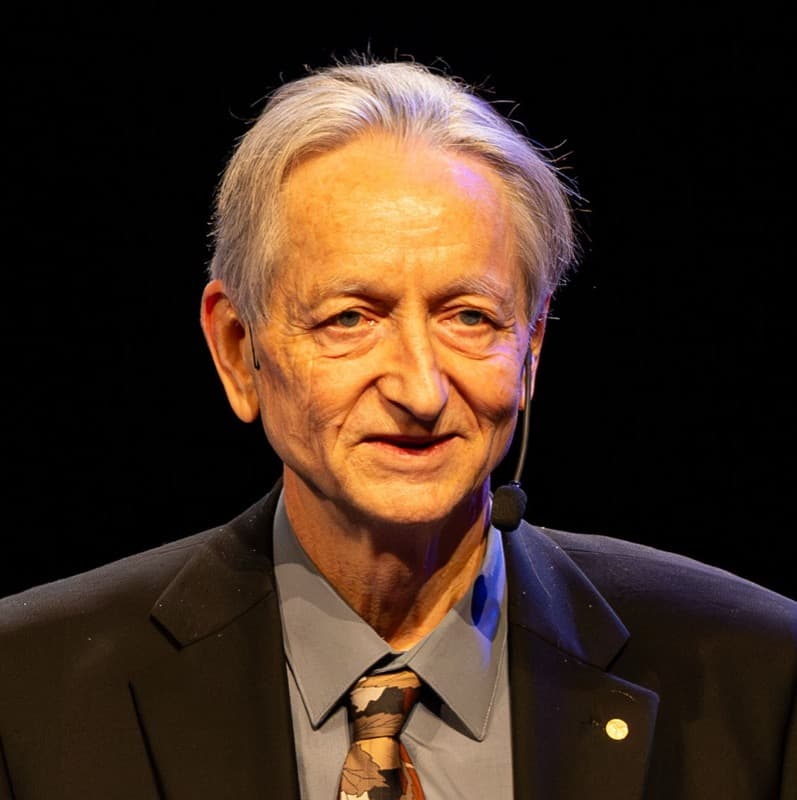
Deep learning pioneer turned leading risk witness
Geoffrey Hinton
Neural networks that learn from data, rather than hand-built symbolic rules, are the route to machine intelligence. But digital intelligence is improving faster than our ability to control it, and the people who built it owe the public an honest account of that risk.
Read the profile
ConvNet inventor betting against the LLM consensus
Yann LeCun
Auto-regressive language models trained on text cannot reach human-level intelligence, because they lack an understanding of the physical world, persistent memory, real reasoning, and the ability to plan. The path forward is world models: systems that learn how reality behaves from sensory data, using architectures like JEPA rather than next-token prediction.
Read the profile
Deep learning pioneer who became safety's leading scientist
Yoshua Bengio
The learning methods Bengio helped create are now producing agentic systems that show early signs of deception and self-preservation, and commercial incentives will not fix this on their own. Safety has to be a design property, built into non-agentic systems that explain the world rather than pursue goals in it.
Read the profile
AlphaGo, AlphaFold, and a Nobel Prize for scientific AI
Demis Hassabis
Intelligence is best built as a general learning system, trained against hard problems rather than engineered by hand, and its highest use is accelerating scientific discovery. Games were the proving ground, proteins were the proof, and drug discovery is the business.
Read the profile
Scaling laws and the safety-first frontier lab
Dario Amodei
Capabilities scale predictably with compute and data, so the frontier is coming whether or not anyone is ready for it. The rational response is not to stop scaling but to build the lab that scales most responsibly, so that safety research rides the same curve as capability.
Read the profile
Creating ImageNet and championing human-centered AI
Fei-Fei Li
Intelligence is grounded in perception and action in the three-dimensional world, not in text alone. Machines that can see, reason about, and construct physical spaces will unlock capabilities that language models structurally cannot reach, and the whole enterprise must be built to serve human needs rather than abstract benchmarks.
Read the profile
The field's educator, Software 2.0 and 3.0, nanoGPT
Andrej Karpathy
Software is being rewritten three times over: first as explicit code, then as trained neural network weights, now as natural language prompts steering large models. The practical craft of the next decade is learning to program all three, while keeping fallible AI systems on a short leash.
Read the profile
Keras creator who redefined how we measure machine intelligence
François Chollet
Intelligence is not skill at tasks but the efficiency with which a system acquires skill at novel problems. Scaling language models buys skill with data and compute rather than producing that efficiency, so general intelligence requires a different architecture, most likely built on program synthesis.
Read the profileThe field's most persistent internal critic
Gary Marcus
Large language models are powerful pattern matchers, not paths to general intelligence. Real progress requires hybrid systems that combine learning with explicit reasoning, and real safety requires verification instead of vibes.
Read the profile
Mapping the material and labor costs of AI systems
Kate Crawford
AI is not disembodied software but an industrial system built from extracted minerals, energy, invisible human labor, and classified data. Understanding it requires following its material supply chains and asking who holds power, not marveling at abstractions or debating hypothetical superintelligence.
Read the profilePortraits via Wikimedia Commons and public sources
Newsletter
New papers, when they are ready. One email per analysis, nothing else.